Epic Research is not viewable using Internet Explorer. Please try accessing it with an alternate browser.
Contributors

After Their Initial Diagnosis, Many Adult COVID-19 Patients Continue Seeking Medical Care for up to Six Months or More

Abstract: COVID-19 related health care utilization persists in a subset of patients for 180 days or more after their initial diagnosis.
September 1, 2021
Glenn Melnick, PhD | June F. O’Leary, PhD

Definitions and guidance regarding the evaluation and care for patients with “Long COVID,” post-COVID conditions or PASC (post-acute sequalae of COVID-19) continues to evolve.1 We sought to describe health care utilization over time after an initial COVID-19 diagnosis. For the purpose of this analysis, follow-up after a health care claim with a confirmed or probable COVID-19 diagnosis was divided into three timeframes including a ≤30-day acute period and 2 subsequent post-acute periods of 31-90 days and 91-180 days.2,3

We analyzed claims data of a large national insurer covering adult commercial (18 to <65 years) and Medicare Advantage (≥65 years) members in 2020. To describe utilization patterns over time, we first identified a patient’s initial health care claim coded with a confirmed or probable COVID-19 diagnosis and further categorized patients by month of initial diagnosis and age group. From 20,768,078 adult members, we identified 264,849 individuals with a confirmed or probable COVID-19 diagnosis and at least one day of enrollment between March 1, 2020 and July 31, 2020.4 This analysis relied on an initial confirmed or probable COVID-19 diagnosis as coded on health care claims, and therefore patients and utilization may be missing (e.g., patient presents with post-COVID symptoms but never received a COVID-19 diagnosis), and medical details and actual care delivered is unknown.

Depending on age group, 3-6% of patients first diagnosed during this 5-month window had at least one COVID-19 related health care claim 91-180 days later. These results are consistent with growing evidence suggesting it may take weeks to fully recover from COVID-19, and that 10% or more of patients may continue to experience symptoms for at least 3 months and some as long as 9 months or more.5-8

Figure 1
Percentage of Patients with One or More COVID-Related Claims Through 180 Days
Table 1. Percentage of patients that had at least one COVID-related claim after their initial COVID-19 diagnosis by age group and time passed between initial diagnosis and follow-up encounter .

We found that the majority of COVID-19 cases do not require hospitalization, and health care utilization, as measured by claims, is greatest in the 30 days after a COVID-19 diagnosis. Approximately 5% of all commercially insured and Medicare Advantage covered adults continue to seek some type of outpatient or inpatient care that is identified as being related to their COVID-19 diagnosis 90-180 days before. Of note, 1% (825/83,946) of Medicare Advantage members (≥65 years) experienced an inpatient stay related to COVID-19 that occurred 90-180 days after a claim identifying their initial diagnosis.

Utilizing health system data to further understand the course of the COVID-19 pandemic is foundational to improved population health management of COVID-19 moving forward.
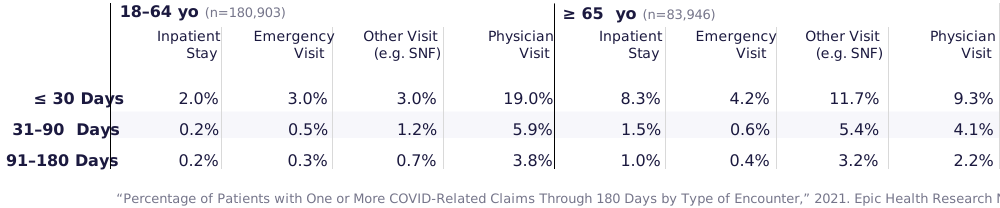
Figure 2
Percentage of Patients with One or More COVID-Related Claims Through 180 Days by Type of Encounter
Table 2. Percentage of patients that had at least one COVID-related claim after their initial COVID-19 diagnosis by type of encounter.

References

  1. CDC (Centers for Disease Control and Prevention). Evaluation and Caring for Patients with Post-COVID Conditions: Interim Guidance. June 14, 2021. https://www.cdc.gov/coronavirus/2019-ncov/hcp/clinical-care/post-covid-index.html. There are now many articles that have been published on post-COVID-19 conditions within the U.S. and abroad, which have contributed to continued congressional hearings (https://energycommerce.house.gov/committee-activity/hearings/hearing-on-the-long-haul-forging-a-path-through-the-lingering-effects-of) and $1.15 billion in NIH funding to further understanding of the entire spectrum of COVID-19 beyond initial infection (https://www.nih.gov/about-nih/who-we-are/nih-director/statements/nih-launches-new-initiative-study-long-covid).
  2. Datta SD, Talwar A, Lee JT. A Proposed Framework and Timeline of the Spectrum of Disease Due to SARS-CoV-2 Infection: Illness Beyond Acute Infection and Public Health Implications. JAMA. 2020;324(22):2251–2252. doi:10.1001/jama.2020.22717.
  3. Hernandez-Romieu AC, Leung S, Mbanya A, et al. Health Care Utilization and Clinical Characteristics of Nonhospitalized Adults in an Integrated Health Care System 28–180 Days After COVID-19 Diagnosis – Georgia, May 2020–March 2021. MMWR Morb Mortal Wkly Rep 2021;70:644-650. DOI:http://dx.doi.org/10.15585/mmwr.mm7017e3.
  4. World Health Organization Emergency use ICD codes for COVID-19 disease outbreak (https://www.who.int/standards/classifications/classification-of-diseases/emergency-use-icd-codes-for-covid-19-disease-outbreak) and Centers for Medicare and Medicaid Services (CMS) New Waivers for Inpatient Prospective Payment System (IPPS) Hospitals, Long-Term Care Hospitals (LTCHs), and Inpatient Rehabilitation Facilities (IRFs) due to Provisions of Inpatient Rehabilitation Facilities (IRFs) due to Provisions of the CARES Act (https://www.cms.gov/outreach-and-educationoutreachffsprovpartprogprovider-partnership-email-archive/2020-04-15-mlnc-se).
  5. Tenforde MW, Kim SS, Lindsell CJ, et al. Symptom Duration and Risk Factors for Delayed Return to Usual Health Among Outpatients with COVID-19 in a Multistate Health Care Systems Network – United States, March–June 2020. MMWR Morb Mortal Wkly Rep 2020;69:993-998. DOI:http://dx.doi.org/10.15585/mmwr.mm6930e1.
  6. Logue JK, Franko NM, McCulloch DJ, et al. Sequelae in Adults at 6 Months After COVID-19 Infection. JAMA Netw Open. 2021;4(2):e210830. doi:10.1001/jamanetworkopen.2021.0830.
  7. Britain’s Office for National Statistics. Prevalence of ongoing symptoms following coronavirus (COVID-19) infection in the U.K. 1 April 2021: Estimates of the prevalence of self-reported “long COVID,” and the duration of ongoing symptoms following confirmed coronavirus infection, using U.K. coronavirus (COVID-19) Infection Survey data to 6 March 2021. https://www.ons.gov.uk/peoplepopulationandcommunity/healthandsocialcare/conditionsanddiseases/bulletins/prevalenceofongoingsymptomsfollowingcoronaviruscovid19infectionintheuk/1april2021.
  8. FAIR Health. A Detailed Study of Patients with Long-Haul COVID: An Analysis of Private Healthcare Claims. June 15, 2021.
