Epic Research is not viewable using Internet Explorer. Please try accessing it with an alternate browser.
Displaying 1-20 of 312 Articles

All Articles

Risk of Repeat Overdose by GLP-1 StatusExpand
July 9, 2026

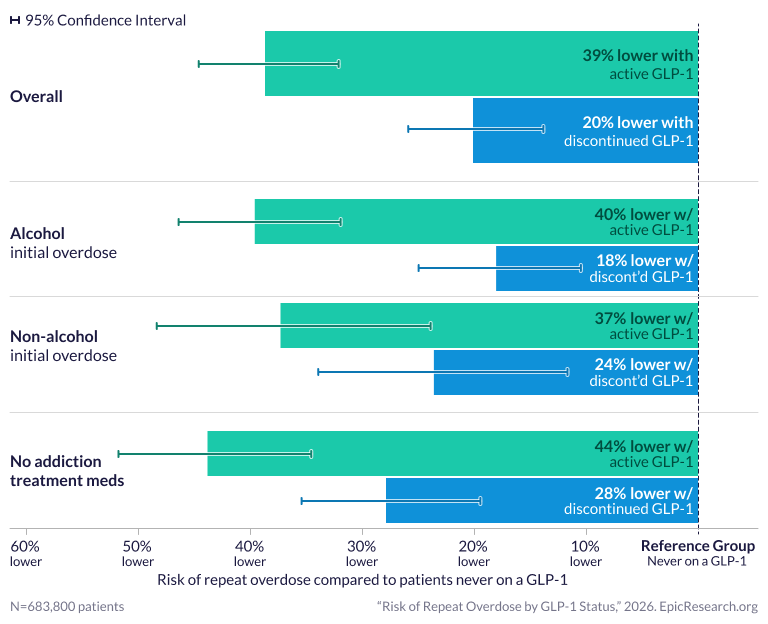
GLP-1 Treatment Associated with a 39% Lower Risk of Repeat Substance Overdose

Among adults who have had a documented substance overdose, those who started on a GLP-1 had a 39% lower risk of a repeat overdose within three years of their overdose compared to patients who were never prescribed a GLP-1. Patients who started and later discontinued a GLP-1 still had a 20% lower risk than patients who never used a GLP-1.

Projected Colorectal Cancer Detection Rates for Routine Screenings Starting at Age 45Expand
June 18, 2026

Projected Colorectal Cancer Detection Rates in Adults Under Age 45

Based on colorectal cancer detection rates among more than 3 million screening-eligible adults, our model estimates that at age 40 approximately 111 cancers would be detected per 100,000 screenings, compared with 159 per 100,000 screenings at age 45, the current recommended starting age. Based on the model, this equates to nearly 44% more 40-year-olds needing to be screened to detect one colorectal cancer (CRC) case compared to the number of 45-year-olds who would need to be screened.

Surgical Site Infection Likelihood After Knee ReplacementExpand
May 14, 2026

Preoperative Weight Change Associated with Higher Likelihood of Complications After Hip and Knee Replacement

Most patients who lost weight before hip or knee replacement had a higher likelihood of surgical site infection and mechanical failure than patients in the same starting BMI class whose weight remained stable. For infection, the likelihood increased with each level of loss, reaching more than six times as likely among overweight patients who lost 20% or more before knee replacement.

Quarterly Rate of Low-Dose Aspirin per Primary Care EncounterExpand
April 16, 2026

Low-Dose Aspirin Usage for Primary Prevention of Cardiovascular Disease Has Fallen by More Than Half Since 2018

The proportion of primary care encounters with low-dose aspirin on the medication list fell by more than half, from a peak of 7.4% in mid-2018 to 3.2% by the end of 2025, among patients without a history that warrants low-dose aspirin for secondary prevention. The decline was observed across all demographic subgroups. Adults aged 80+ still had the highest prevalence at 5.7%.

12-Month Rolling Rate of Overdose Emergency Department Visits Over TimeExpand
February 26, 2026

Fentanyl Testing Associated with Short-Term Survival Benefits; Increased Long-Term Mortality Risk Among Overdose Patients

The 12-month average rate of emergency department (ED) visits for overdoses of all types declined from a peak of 946 per 100,000 ED visits in March 2021 to 634 per 100,000 ED visits in November 2025, falling below pre-COVID-19 pandemic levels. Testing for fentanyl in these encounters more than quadrupled over this period, from 5% of encounters to 28% of encounters.

BMI Distribution Among Patients with MASLDExpand
February 19, 2026

“Lean MASLD” Typically Clustered Near Obese BMI Threshold

Among adults aged 45 to 64 who were diagnosed with metabolic dysfunction-associated steatotic liver disease (MASLD), those with a non-obese BMI (below 30) were skewed just below the obese BMI threshold with more than 80% having an overweight BMI (25.0–29.9).