Epic Research is not viewable using Internet Explorer. Please try accessing it with an alternate browser.
Cosmos Study
COVID-19 During Pregnancy: Birth and Infant Outcomes
Abstract: We identified cases of preterm birth, low birth weight, and congenital heart defects in babies born to mothers with COVID-19 during pregnancy.
Team A:Jackie Gerhart, MD|Greg Sharpe|Joe McNitt|Lily Rubin-Miller, MPH
Team B:Sam Fallahian, MD|Alejandro Muñoz del Río, PhD|Nicole Bertram, MS|Justin Lo, PhD MT(ASCP)|Vivek Nuthalapati, MS
It is largely unknown how COVID-19 in pregnancy affects a newborn. To date, studies have shown varied findings and most have had small sample sizes1,2. We studied a large population of 151,548 pregnant mothers, of whom 4,054 were COVID-19 positive at some point during their pregnancy before their labor admission.
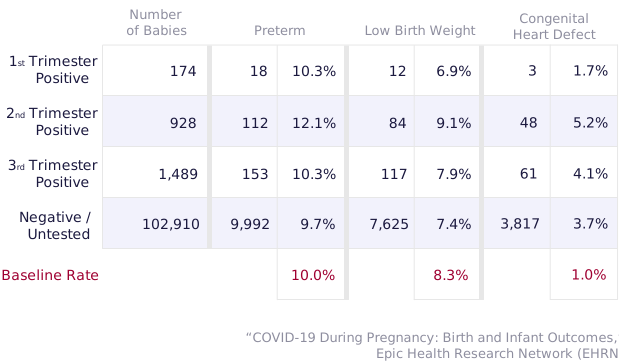
Figure 1 shows the number of babies with each of the studied outcomes by trimester in which the mother was first COVID-19 positive. Some of the outcomes we studied were rare. For example, despite our large study population of 4,054 COVID-19-positive mothers, there were 178 babies with a congenital heart defect overall, and only four of them were born to mothers who contracted COVID-19 in their first trimester. This makes it difficult to assess the trimester-specific risk associated with COVID-19 from our data.
Figure 1
Figure 1
Figure 1: The total number of babies born and their outcomes, by trimester the mother was first identified as COVID-19 positive. Baseline rates are for reported outcomes in the general US population3–5.
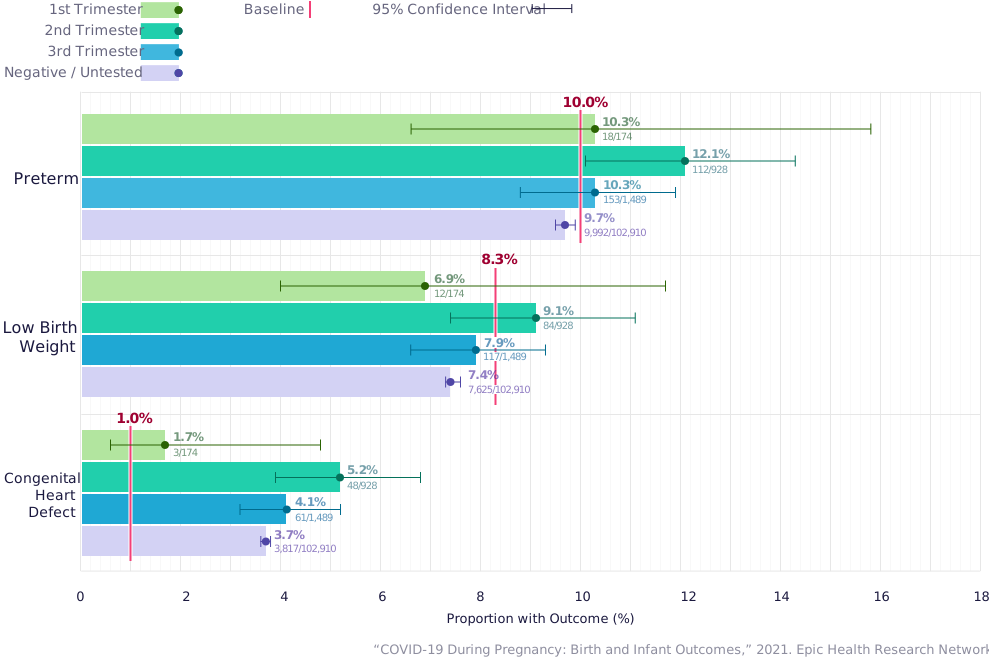
Figure 2 shows the proportion of babies with preterm labor, low birth weight, and congenital heart defect among COVID-19-positive mothers, by trimester first identified as positive, compared to mothers who were either negative or untested. This is also compared to the baseline rate as published by the CDC3–5.
Figure 2
Figure 2
Figure 2: Outcomes for babies, by trimester the mother was first identified as COVID-19 positive, as compared to babies born to negative or untested mothers. Each baseline rate, as published by the CDC, is shown by the vertical red lines. 95% confidence intervals are shown in the horizontal lines for each bar.
About our Data:
Our data include all test results and diagnoses from delivering mothers seen at healthcare organizations contributing to the data set during the study period. People who are tested in health systems often have underlying reasons to be visiting a hospital or clinic other than just getting a COVID-19 test. These factors, such as COVID-19 symptoms, social context6, or increased interaction with healthcare, could affect our data. Therefore, we are unable to say whether these results are generalizable to all pregnant mothers.
This study was completed by two teams (A: GS, JG, JM, LR-M; B: AMR, NB, JL, SF, VN), each comprised of a clinician and several data scientists, who independently acquired and analyzed data. Both teams were involved in the interpretation of results and drafting of this brief. Overall, the two teams came to similar conclusions. Data are pooled from 65 healthcare organizations, analyzing 151,548 births between March 15, 2020 and November 30, 2020.
Data are pooled from 65 healthcare organizations, analyzing 151,548 births between March 15, 2020 and November 30, 2020.
References:
References
Smith V, Seo D, Warty R, et al. Maternal and neonatal outcomes associated with COVID-19 infection: A systematic review. PLOS ONE. 2020;15(6):e0234187. doi:10.1371/journal.pone.0234187
Allotey J, Stallings E, Bonet M, et al. Clinical manifestations, risk factors, and maternal and perinatal outcomes of coronavirus disease 2019 in pregnancy: living systematic review and meta-analysis. BMJ. 2020;370:m3320. doi:10.1136/bmj.m3320
Centers for Disease Control and Prevention. Preterm Birth. Published October 30, 2020. Accessed February 19, 2021. https://www.cdc.gov/reproductivehealth/maternalinfanthealth/pretermbirth.htm
Centers for Disease Control and Prevention. Birthweight and Gestation. Published August 4, 2020. Accessed February 19, 2021. https://www.cdc.gov/nchs/fastats/birthweight.htm
Centers for Disease Control and Prevention. Data and Statistics on Congenital Heart Defects. Centers for Disease Control and Prevention. Published December 9, 2020. Accessed February 19, 2021. https://www.cdc.gov/ncbddd/heartdefects/data.html
Blumenshine P, Egerter S, Barclay CJ, Cubbin C, Braveman PA. Socioeconomic Disparities in Adverse Birth Outcomes: A Systematic Review. Am J Prev Med. 2010;39(3):263-272. doi:10.1016/j.amepre.2010.05.012