


While several cases of reinfection with SARS-CoV-2 have been reported,1–3 it remains unclear how frequently these events occur. The CDC suggests that a positive test within 90 days of initial onset of illness is more likely to represent continued viral shedding than a reinfection.4 Based on this, we used the time between positive COVID tests as an indication for which patients were possibly reinfected. We determined that 0.4% of patients who previously had COVID were possibly reinfected.
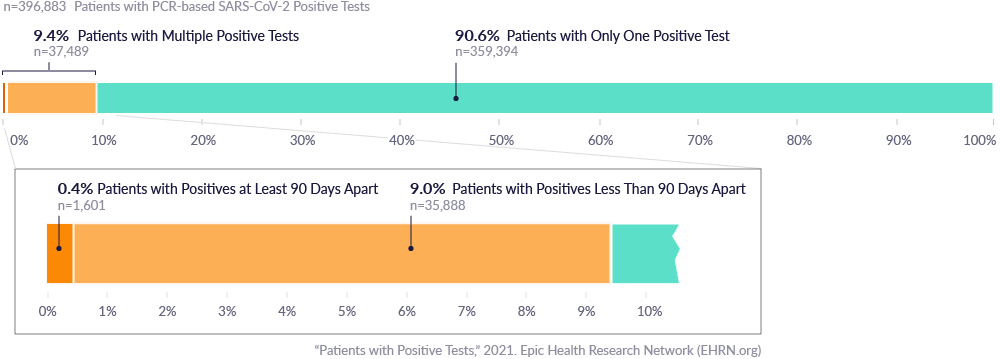
We reviewed PCR-based SARS-CoV-2 laboratory tests from 98 healthcare organizations, covering 63 million patients. There were 396,883 patients that had at least one positive result, and 37,489 patients that had two or more positive test results during our study window. We found 1,601 patients (0.4%) who had a subsequent positive test at least 90 days after their initial positive test, indicating possible reinfection.
Figure 1 illustrates the patient population with positive tests and the subset of patients with multiple positive tests broken out by less than 90 days between positive tests and at least 90 days between positive tests.
As another proxy for reinfection and to evaluate disease severity, we looked at the patients who had a subsequent positive test at least 90 days after the first to see how many were admitted or died within 21 days of their most recent positive test. Of the 1,601 patients, 496 (31.0%) were admitted to the hospital within 21 days of their most recent positive test and 54 (3.4%) died within 21 days of their most recent positive test. We speculate that these patients with hospital admissions or deaths are more likely to represent true reinfections.
Subsequent positive tests could be due to residual shedding, actual reinfection, or other reasons that require more analysis. Our findings are based solely on length of time between positive tests and do not consider genomic sequencing data.
