Epic Research is not viewable using Internet Explorer. Please try accessing it with an alternate browser.
Cosmos Study

Long COVID? Long Flu? Long Pneumonia? Yes. They All Happen.

June 14, 2022
Dual-Team Study
Team A:Steve Allen, MDJoey Haddock
Team B:Jeff Trinkl, MDEric BarkleyRachel Caron

Key Findings

  • Patients also seek care for long-term symptoms after non-COVID, non-influenza viral pneumonia and influenza infections.
  • Those hospitalized with non-COVID, non-influenza viral pneumonia are more likely to seek care for long-term symptoms than those who do not require hospitalization.
  • These findings suggest that respiratory infections other than COVID-19 might also require care for long-term symptoms.

In July 2021, we found that 9.4% of COVID-19 patients sought treatment for symptoms that might indicate long COVID.1 A recent study suggested that COVID-19 might not be the only respiratory infection that causes chronic post-infectious symptoms.2 We studied the rate at which influenza or viral pneumonia patients subsequently had long-term symptoms.

Our study population comprised three groups: patients diagnosed with COVID-19 between January 1, 2020, and July 1, 2021; patients diagnosed with a non-COVID, non-influenza viral pneumonia between January 1, 2018, and July 1, 2019; and patients diagnosed with influenza between January 1, 2018, and July 1, 2019. For each group, we compared two rates:

  1. Rate of New Symptoms Prior to Infection. The percentage of patients who sought treatment for a novel long-term symptom between 180 days and 28 days before infection. This establishes a “baseline” rate of these symptoms among each group in the absence of infection.
  2. Rate of New Long-Term Symptoms After Infection. The percentage of patients who did not experience a specific long-term symptom before infection but sought treatment for that symptom 28 days to 180 days after infection.

The difference between these rates represents long-term symptoms related to the infection.

Following an infection with either COVID-19 or other viral pneumonia, an additional 3.7% of patients reported new long-term symptoms. Among patients infected with influenza, an additional 1.5% of patients reported new long-term symptoms.
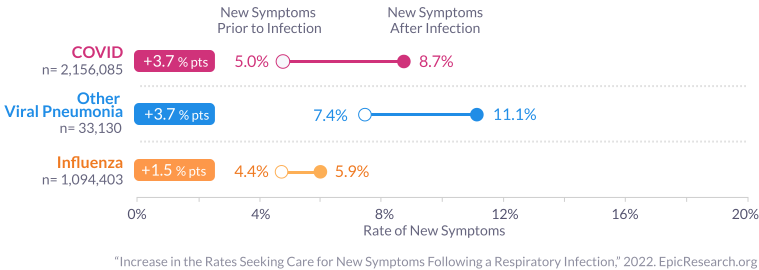
Figure 1
Increase in Patients Seeking Care for New Symptoms Following Respiratory Infection
Figure 1. The rates of patients who sought treatment for symptoms typical of long COVID after a respiratory infection. For each group, “Prior to Infection” represents the percentage of patients who sought treatment for a novel characteristic long COVID symptom 180 days to 28 days before infection, while “After Infection” represents patients who sought treatment for a novel symptom 28 days to 180 days after infection.

Patients whose respiratory infections led to hospitalization sought treatment at higher overall rates than the total population. Among this cohort, an additional 5.4% of COVID-19 patients, 6.4% of influenza patients, and 5.2% of patients with other viral pneumonia sought treatment after infection.
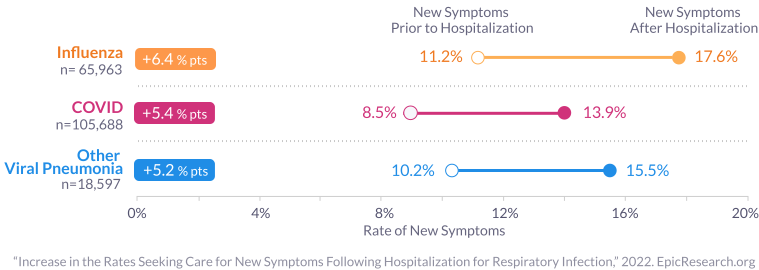
Figure 2
Increase in Patients Seeking Care for New Symptoms Following Hospitalization for Respiratory Infection
Figure 2. The rates of patients who sought treatment for symptoms typical of long COVID after being hospitalized with a respiratory infection. For each group, “Prior to Hospitalization” represents the percentage of patients who sought treatment for a novel characteristic long COVID symptom 180 days to 28 days before infection, while “After Hospitalization” represents patients who sought treatment for a novel symptom 28 days to 180 days after infection.

The intense focus on understanding COVID-19 has created increased awareness of chronic, post-viral symptoms around COVID-19 infections. Patients who contract other respiratory infections and their doctors should also be aware of the potential for—and be prepared to treat—similar chronic symptoms. More research is needed to determine the precise causes and risk factors for long-term post-viral symptoms.


These data come from Cosmos, a HIPAA-defined Limited Data Set of more than 142 million patients from 166 Epic organizations including 1000 hospitals and 21,481 clinics, serving patients in all 50 states. This study was completed by two teams who worked independently, each composed of a clinician and research scientists. The two teams came to similar conclusions.

References

  1. Rohrer-Meck, K., Marchena, D., Rubin-Miller, L., Bregman, H., Lo, J., & Sandberg, N. (2021).Nearly 1 in 10 COVID Patients Seek Treatment for Long-Term Symptoms. Epic Health Research Network. https://epicresearch.org/articles/nearly-1-in-10-covid-patients-seek-treatment-for-long-term-symptoms
  2. Taquet, M., Dercon, Q., Luciano, S., Geddes J.R., Husain, M., & Harrison, P.J. (2021). Incidence, co-occurrence, and evolution of long-COVID features: A 6-month retrospective cohort study of 273,618 survivors of COVID-19. PLoS Med, 18(9), Article e1003773. https://doi.org/10.1371/journal.pmed.1003773