Epic Research is not viewable using Internet Explorer. Please try accessing it with an alternate browser.
Cosmos Study

Mental Health During the COVID-19 Pandemic

Abstract: Outpatient visits for depression or anxiety have increased, while suicide-related ED visits have returned to pre-pandemic levels.
March 25, 2021
Dual-Team Study
Team A:Jeff Trinkl, MDJustin Lo, PhD, MT(ASCP)Steve Monson
Team B:Dave Little, MDDavid Berry, PhDZach Cohen

The CDC reports rates of anxiety, depression, and suicidal ideation seem to be rising during the pandemic.1 We wondered whether mental health visits were also on the rise. We studied whether outpatient visits for depression or anxiety and ED visits for suicidal ideation, suicide attempt, or self-harm were increasing.

Outpatient Visits

In the outpatient setting, there was a sharp decline in anxiety and depression visits at the onset of the pandemic, but visit volume returned to pre-pandemic levels by June and has now exceeded the forecasted level, as shown in Figure 1.
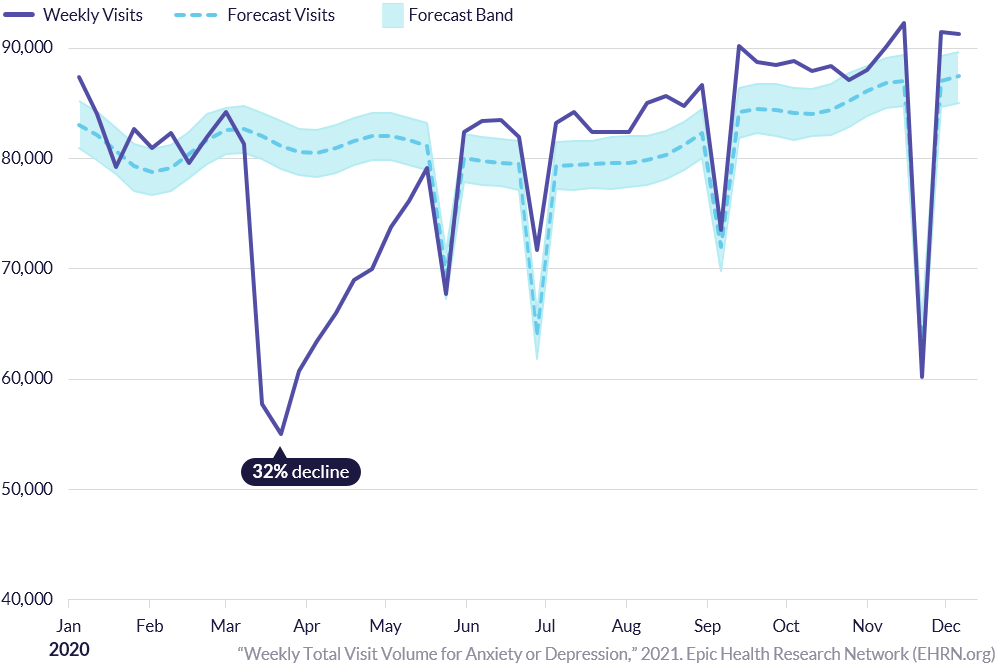
Figure 1
Weekly Total Visit Volume for Anxiety or Depression
Figure 1. Outpatient visits including phone, telehealth, in-person, and ED visits for anxiety or depression from January through December 2020. The sharp decreases after June are expected for the holidays. The forecast uses visit volumes from January 2018 through December 2019 to predict volumes for 2020.

Prior to the pandemic, 79% of outpatient visits for depression or anxiety were in-person office visits, 18% ED visits, 3% telephone, and 0.1% telehealth. Telehealth visits for patients with anxiety or depression grew dramatically in response to the pandemic, as reported initially in August 2020.2

We then compared in-person office visit and telehealth visit volumes for depression or anxiety (Figure 2). In the weeks prior to the pandemic, we observed minimal telehealth activity. Telehealth visits skyrocketed in March and April and exceeded in-person visits for several weeks. When office visits began to increase in mid-April through July, telehealth visits plateaued at a level of approximately 20,000 per week. Telehealth visits have remained an important source of contact, comprising 28% of the total visit volume at the end of 2020.
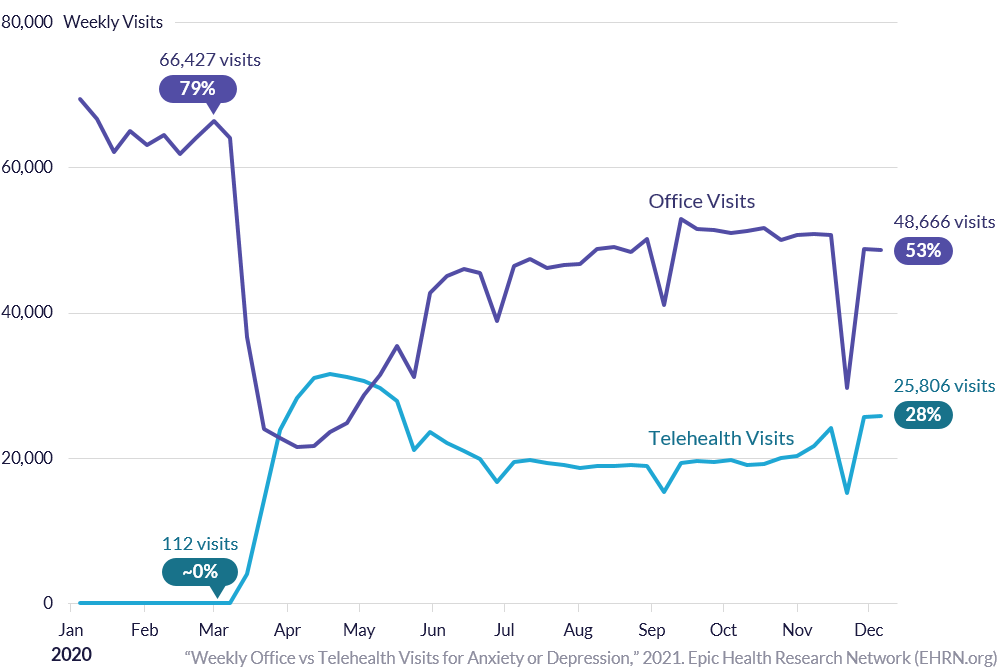
Figure 2
Weekly Office Visit vs. Telehealth Visits for Anxiety or Depression
Figure 2. Telehealth and office visit volume from January 2020 through December 2020. Percentages indicate the total number of each visit type out of all outpatient visits for anxiety or depression. Office visits are now 53% and telehealth visits are now 28% of all outpatient visits, with the remainder being ED and telephone visits.

Emergency department visits for suicide-related diagnoses rose steadily through 2018-2019, peaking at 2,665 visits per week in our sample in March 2020. At the outset of the pandemic, suicide-related ED visits dropped abruptly, in alignment with overall ED visits.3 Figure 3 shows ED visits related to suicide have returned to pre-pandemic levels but have not increased.

Emergency Department Visits
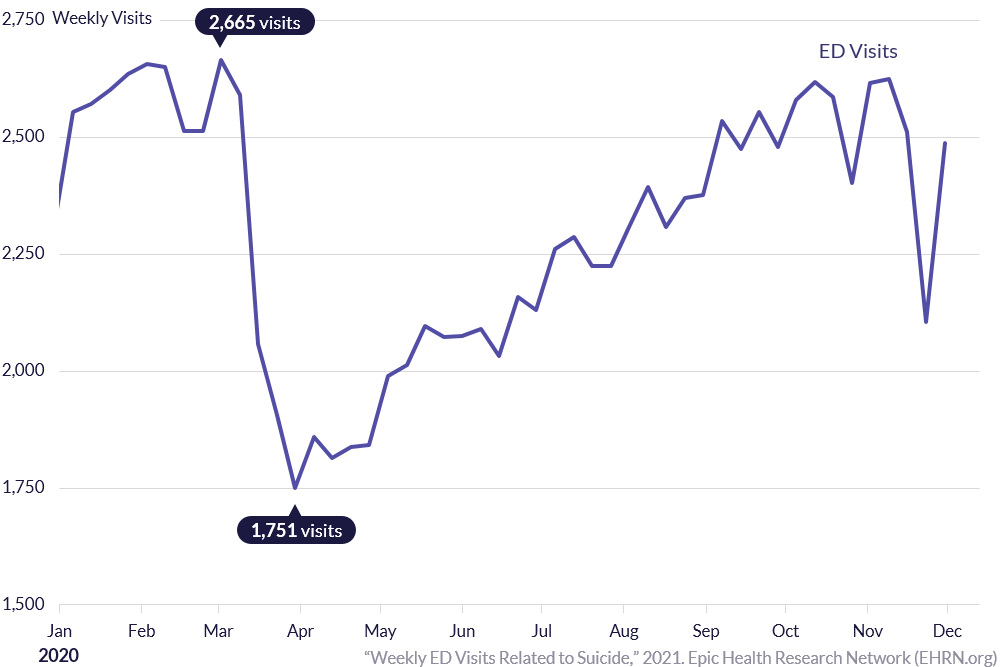
Figure 3
Weekly ED Visits Related to Suicide
Figure 3. ED visits for suicide-related diagnoses from January to December 2020.

ED visits for patients with anxiety or depression showed a similar trend, with a steep initial drop during the pandemic and then return to nearly pre-pandemic levels. Compared to suicide-related ED visits, ED visits for depression or anxiety returned to pre-pandemic levels more quickly (Figure 4).
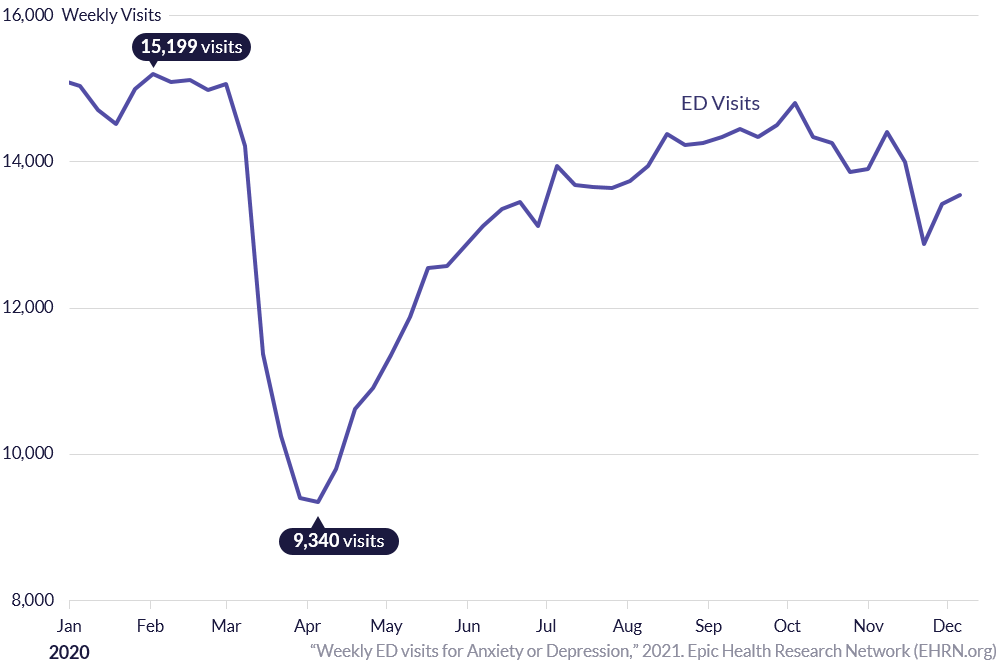
Figure 4
Weekly ED Visits for Anxiety or Depression
Figure 4. ED visits for anxiety or depression from January to December 2020.

Summary

When we looked at telehealth visits for anxiety and depression back in June, we were unsure whether the volume would continue to rise, or if it would decrease as physician offices reopened. While office visits remain lower than pre-pandemic, total outpatient visits are up, mainly due to the increase in telehealth.

We did not see an increase in anxiety, depression, or suicide-related ED visits compared to pre-pandemic levels. We recognize that suicide-related ED visit volumes do not capture the overall rates of suicide attempts or deaths in the general population. Because our data include only deaths that occur in the hospital setting, further study is needed to assess the overall suicide rate in the population.


This study was completed by two teams (A: JT, JL, SM; B: DL, DB, ZC), each comprised of a clinician and two data scientists, which independently acquired and analyzed data. Both teams were involved in the interpretation of results and drafting of this brief. Overall, the two teams came to similar conclusions. Data are pooled from 45 healthcare organizations that cover 28 million patients. 32 of the 45 healthcare organizations that contributed data to this study did not exclude any behavioral health encounters; the remaining organizations excluded behavioral health encounters that met certain criteria, and those restrictions applied to the entire study period (January 1, 2018 through December 27, 2020).

References

  1. Czeisler MÉ, Lane RI, Petrosky E, et al. Mental Health, Substance Use, and Suicidal Ideation During the COVID-19 Pandemic — United States, June 24–30, 2020. Morb Mortal Wkly Rep. 2020;69(32):1049-1057. doi:10.15585/mmwr.mm6932a1
  2. Trinkl J, Muñoz del Río A. Effect of COVID-19 Pandemic on Visit Patterns for Anxiety and Depression. Epic Health Research Network. Accessed February 3, 2021. https://ehrn.org/articles/effect-of-covid-19-pandemic-on-visit-patterns-for-anxiety-and-depression/index.html
  3. Noel A, Alban C, Trinkl J, et al. Fewer Visits, Sicker Patients: The Changing Character of Emergency Department Visits During the COVID-19 Pandemic. Epic Health Research Network. Accessed February 4, 2021. https://www.ehrn.org/articles/fewer-visits-sicker-patients-the-changing-character-of-emergency-department-visits-during-the-covid-19-pandemic.