For numerous reasons, some patients are tested for SARS-CoV-2 virus multiple times, and a small percentage of patients test positive more than once. We were interested in better understanding how often patients undergo multiple tests, and what the time frame is between the first and last positive results. We speculate that fewer days between repeat positive results likely represents a true positive for live virus. A longer day separation seems to better support the concept of PCR tests detecting non-active viral RNA, as suggested in a recent article from the Korea Centers for Disease Control and Prevention (KCDC).1

Our sample included 1,184,442 patients who were tested as of June 3, 2020. 158,476 patients (13.4%) had at least one positive test. Of these positive patients, 15,998 (10.1%) had a second positive test while 11,958 (7.5%) subsequently only had negative test results.
For patients with two or more positive tests, we looked at the number of days between the first positive test and last positive test. 44.7% of patients had 1 to 14 days of separation. The remainder of the patients ranged from 15 to 79 days.
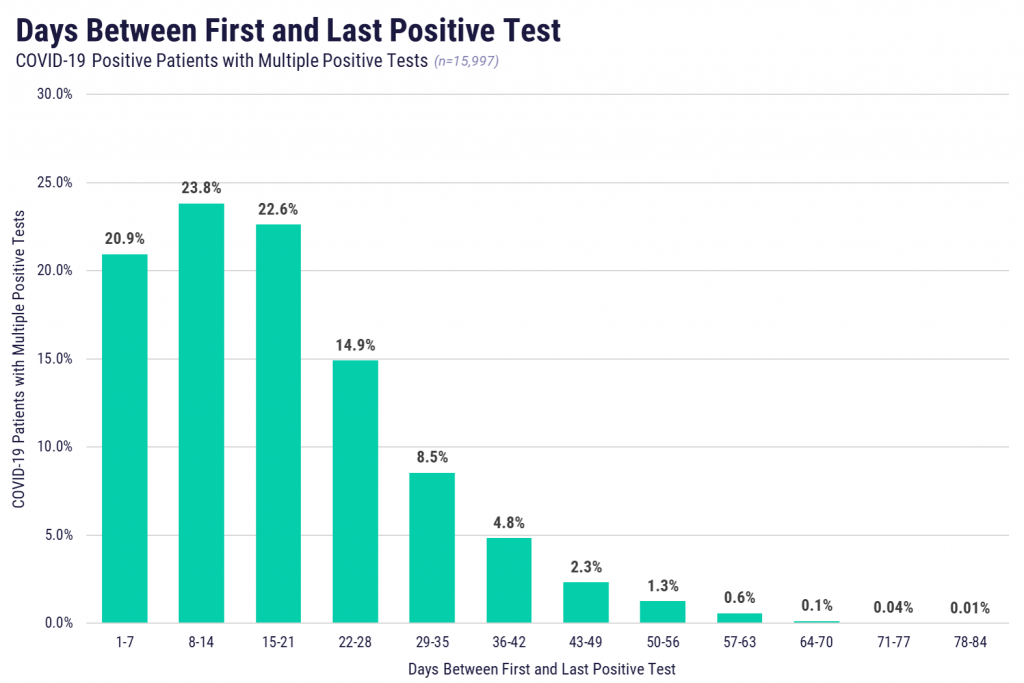
The United States CDC estimates an infected patient is likely to be non-contagious after approximately 10 days.2 For the short interval retest positive patients (1-14 days between first and last positive), we suspect in most cases both of the patients’ positive test results are detecting live virus. The longer interval group (greater than 14 days of test separation) is more interesting considering the likelihood that active virus is no longer present. Possible explanations for this finding include longer than average live viral shedding, detection of non-infectious viral RNA breakdown products, or possible reinfection. Recent studies, such as the KCDC brief, suggest the COVID-19 PCR test is detecting non-infectious viral breakdown products. In the KCDC study, 285 patients with positive retesting underwent contact tracing and a subset of 108 patients had viral cell culture testing. No cultures were positive, and investigation of 790 contacts of the study patients revealed no newly confirmed cases from exposure. Their findings do not support the possible explanation that patients were reinfected.
Considering early research suggesting PCR tests detect non-infectious SARS-CoV-2 RNA for weeks to months beyond symptom onset, it seems a hypothesis of reinfection is less likely.3 We plan to continue collecting PCR test data to investigate if the retest positive rate changes as the time interval between the first and last positive test increases. Evaluation of future test data may give some insights into how long a patient is immune to reinfection after a COVID-19 infection.
Data are pooled from 52 health systems representing 259 hospitals that span 26 states and cover 15 million patients.
The article was updated July 3 to clarify that the percentage of patients with a second positive test—10.1%—relates to the total number of patients with at least one positive test, not the total number of patients who received a second test.


