Epic Research is not viewable using Internet Explorer. Please try accessing it with an alternate browser.
Cosmos Study

Trends in COVID-19 Inpatient Therapeutics

Abstract: Global spread of information has shaped the evolving inpatient care of COVID-19; recent leading therapies have been driven by clinical trials.
November 10, 2020
Andrea Noel, MD | Chris Alban, MD, MBA | Amy Breden, MIDS | Eric Lindgren, JD | Justin Lo, PhD, MT(ASCP) | Kieran Gallagher, MPH

In the first seven months of the novel coronavirus pandemic, inpatient therapy choices have been considerably influenced by pre-publications, media attention, clinical trials, emergency use authorizations, and regional drug availability. In this observational study, we examine patterns in inpatient medication use since the start of the pandemic. Use of the leading therapies over time represents the dramatic changes in standard of care for treating hospitalized patients with COVID-19. Dexamethasone and remdesivir are the current dominant therapeutics, and both of these therapies have supportive evidence from randomized clinical trials.1,2
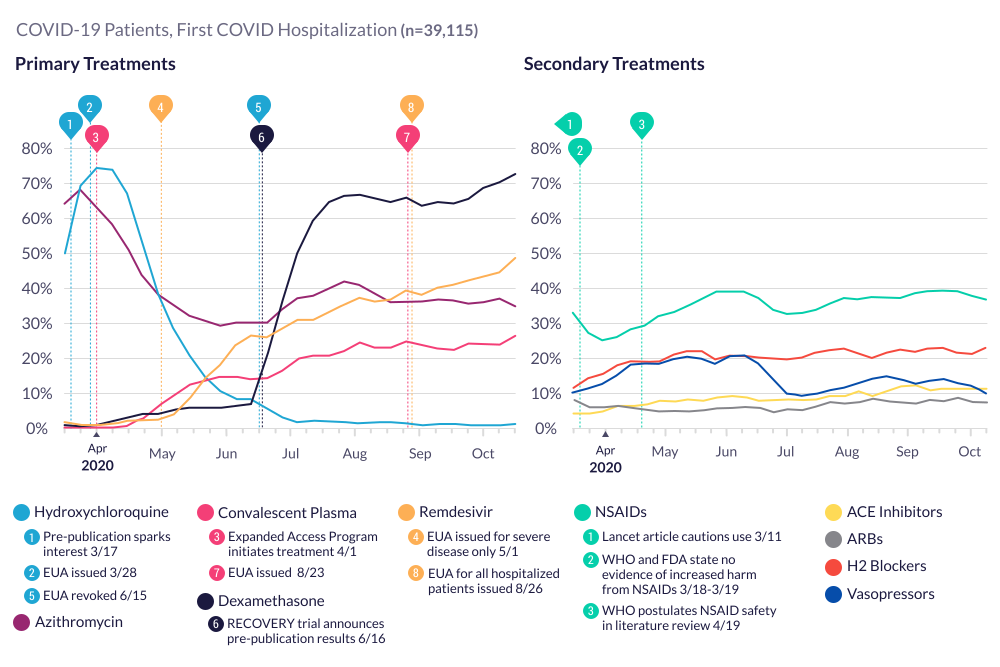
Figure 1
Hospitalized patients with COVID-19 therapeutics over time
Percentage of hospitalized COVID-19 patients by week mid-March through mid-October 2020 who have received the above inpatient therapies. Patients are counted in the denominator each week they are hospitalized any day between Sun-Sat, and in the numerator for the week of hospitalization where the given therapy was initiated and for every subsequent week through the end of their hospitalization. Data represent 39,115 patients across 457 hospitals in 62 hospital systems and 27 US states.

Hydroxychloroquine and azithromycin use were high early in the pandemic after a mid-March pre-publication from France caught global attention3 and the FDA subsequently issued an Emergency Use Authorization (EUA).4 Hydroxychloroquine use declined sharply over the next 10 weeks as the medical and scientific community questioned its efficacy5,6 and had minimal use in hospitalized patients by the time the EUA was revoked.7 Azithromycin use had a parallel decline in April and May, but use never dropped much below 30% of hospitalized patients, possibly due to its indication for community acquired pneumonia or its known immunomodulatory effects.8 Its use did show a midsummer rise around the same time cases in the US were becoming geographically more widespread.

Clinical trials for remdesivir and dexamethasone both showed promise of improving the clinical course for patients, and these drugs showed rising ordering trends after the pre-publication announcements from their respective trials and the issuance of EUAs.9,10 Dexamethasone’s wide availability as a generic drug may have contributed to its more rapid rise in use trends than remdesivir. Convalescent plasma use began to increase after the start of the national expanded access program,11 but also saw an additional rise in midsummer. Whether this was due to changing standard of care or increasing availability of plasma as more patients convalesced is not clear from this data. Its use did not seem meaningfully impacted by the timing of the EUA in August.12

Researchers have proposed therapeutic uses of ACE inhibitors, ARBs, H2 blockers, and NSAIDs for the coronavirus via a variety of mechanisms.13,14,15 ACE inhibitor use has trended slightly upwards over time, while ARB use has not changed appreciably. H2 blocker use accelerated alongside the vasopressor use early in the pandemic, possibly representing co-ordering in critically ill ICU populations, but then persisted around 20% of inpatients through and beyond the midsummer surge. NSAID use had a significant dip after a cautionary letter was published in early March about possible harm,15 but volumes rebounded over time. The use of vasopressors for COVID-19 patients decreased in midsummer with the surge, which may indicate less severe illnesses in the hospitalized population at that time. The slight rebound of vasopressor use in later summer may represent the discharge of those less critical patients.

The standard of care appears to have stabilized over the last several months, with dexamethasone and remdesivir as the forerunners for therapy of COVID-19 inpatients.


References:

References

  1. RECOVERY Collaborative Group, Horby P, Lim WS, et al. Dexamethasone in hospitalized patients with Covid-19 – preliminary report. N Engl J Med. 2020;(NEJMoa2021436). doi:10.1056/NEJMoa2021436
  2. Beigel JH, Tomashek KM, Dodd LE, et al. Remdesivir for the treatment of Covid-19 – preliminary report. N Engl J Med. 2020;(NEJMoa2007764). doi:10.1056/NEJMoa2007764
  3. Gautret P, Lagier JC, Parola P, et al. Hydroxychloroquine and azithromycin as a treatment of COVID-19: results of an open-label non-randomized clinical trial. Int J Antimicrob Agents. 2020;56(1):105949. doi:10.1016/j.ijantimicag.2020.105949
  4. U.S. Food and Drug Administration. FDA. https://www.fda.gov/media/136534/. Accessed September 10, 2020.
  5. Kim AHJ, Sparks JA, Liew JW, et al. A Rush to Judgment? Rapid Reporting and Dissemination of Results and Its Consequences Regarding the Use of Hydroxychloroquine for COVID-19 [published correction appears in Ann Intern Med. 2020 Jun 16;172(12):844]. Ann Intern Med. 2020;172(12):819-821. doi:10.7326/M20-1223
  6. COVID-19 Treatment Guidelines Panel. Coronavirus Disease 2019 (COVID-19) Treatment Guidelines. National Institutes of Health. Available at https://covid19treatmentguidelines.nih.gov/. Accessed October 16, 2020.
  7. U.S. Food and Drug Administration. FDA. https://www.fda.gov/media/138945/. Accessed September 10, 2020.
  8. Reijnders, T., Saris, A., Schultz, M. and van der Poll, T., 2020. Immunomodulation by macrolides: therapeutic potential for critical care. The Lancet Respiratory Medicine, 8(6), pp.619-630.
  9. U.S. Food and Drug Administration. FDA. https://www.fda.gov/media/137564/. Accessed September 10, 2020.
  10. Dexamethasone reduces death in hospitalised patients with severe respiratory complications of COVID-19. University of Oxford. https://www.ox.ac.uk/news/2020-06-16-dexamethasone-reduces-death-hospitalised-patients-severe-respiratory-complications. Accessed September 10, 2020.
  11. Comparing EAP vs. EUA: What you need to know. www.uscovidplasma.org. https://www.uscovidplasma.org/-/media/kcms/gbs/patient-consumer/documents/2020/08/23/18/22/eap-vs-eua.pdf. Published August 25, 2020.
  12. U.S. Food and Drug Administration. FDA. https://www.fda.gov/media/141480/. Accessed September 10, 2020.
  13. Letko M, Marzi A, Munster V. Functional assessment of cell entry and receptor usage for SARS-CoV-2 and other lineage B betacoronaviruses. Nat Microbiol. 2020;5(4):562-569. doi:10.1038/s41564-020-0688-y
  14. Robert W. Malone, Philip Tisdall, Philip Fremont-Smith et al. COVID-19: Famotidine, Histamine, Mast Cells, and Mechanisms. Research Square [PREPRINT]. March 23, 2020. Available at: https://doi.org/10.21203/rs.3.rs-30934/v1.
  15. Fang L, Karakiulakis G, Roth M. Are patients with hypertension and diabetes mellitus at increased risk for COVID-19 infection? The Lancet Respiratory Medicine. 2020;8(4). doi:10.1016/s2213-2600(20)30116-8
  16. Center for Drug Evaluation and Research. FDA advises patients on use of NSAIDs for COVID-19. U.S. Food and Drug Administration. https://www.fda.gov/drugs/drug-safety-and-availability/fda-advises-patients-use-non-steroidal-anti-inflammatory-drugs-nsaids-covid-19. Accessed September 10, 2020.
  17. (WHO) WHO. Q: Could #ibuprofen worsen disease for people with #COVID19?A: Based on currently available information, WHO does not recommend against the use of of ibuprofen. pic.twitter.com/n39DFt2amF. Twitter. https://twitter.com/WHO/status/1240409217997189128. Published March 18, 2020. Accessed September 10, 2020.
  18. The use of non-steroidal anti-inflammatory drugs (NSAIDs) in patients with COVID-19. World Health Organization. https://www.who.int/news-room/commentaries/detail/the-use-of-non-steroidal-anti-inflammatory-drugs-(nsaids)-in-patients-with-covid-19. Accessed September 10, 2020.
