
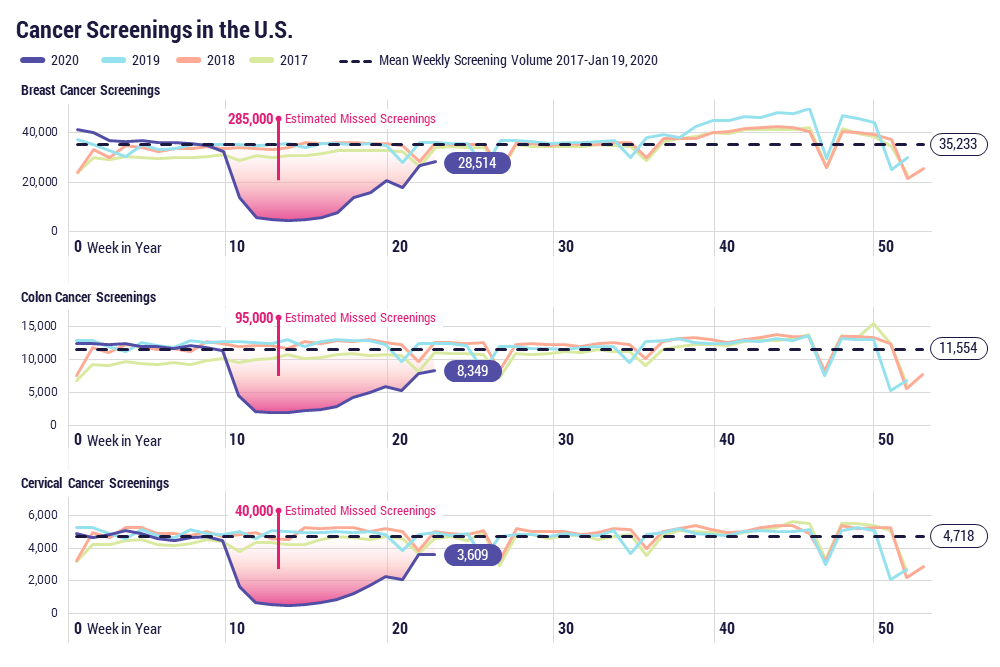
On May 4, 2020, we published a study showing that preventive cancer screenings in the United States abruptly dropped 86% (colon) and 94% (breast and cervical) following the declaration of the COVID-19 national emergency. The number of cancer screenings has recently begun to rise, but has not yet reached previously expected levels: June 16 weekly volumes remained 29%, 36%, and 35% lower than their pre-COVID-19 levels for breast, colon, and cervical cancer screenings. The gap between the expected screenings and the actual screenings created a sizable deficit of “missed” screenings. Between March 15 and June 16, 285,000 (breast), 95,000 (colon), and 40,000 (cervical) exams were missed, which represent deficits of 63%, 64%, and 67% relative to the number of screenings that would be expected based on the historical average. The sample for this analysis is restricted to patients who had at least one encounter in each of the years 2017, 2018, and 2019.
Due to delayed or missed screening, some cancer cases could be diagnosed at a later stage with a poorer prognosis. Provider organizations might wish to explore alternative options to get patients caught up, such as the use of at-home stool-based tests for colon cancer screening or implementing risk-stratification methods to identify and prioritize patients at highest risk (e.g., Gail model to identify patients at highest risk for breast cancer).
Data are pooled from 60 healthcare organizations representing 306 hospitals that span 28 states and cover 9.8 million patients. The number of cancer screenings completed each week in 2020 is compared to the expected number of screenings for equivalent weeks from 2017 through January 19, 2020, the day before the first U.S. COVID-19 case was found.


