 Expand
January 16, 2025
Childhood Speech Delay Rates Have Not Fallen After Post-Pandemic Surge
Speech delay diagnoses among toddlers increased between Q1 2018 and Q4 2021 and remained steady at 16-17% in 2023 and 2024.
ExpandSpeech delay diagnoses among toddlers increased between Q1 2018 and Q4 2021 and remained steady at 16-17% in 2023 and 2024.
 Expand
Children diagnosed with autism spectrum disorder (ASD) are 49% more likely to be diagnosed with leukemia than children without ASD.
 Expand
In all countries outside of the United States (U.S.), night shift is less likely to be staffed by newer nurses than day shift. However, in the U.S., a larger portion of night shifts are covered by low-tenure nurses than day shift.
 Expand
In the span of one year, more than 5.8 million duplicate imaging orders were potentially prevented.
 Expand
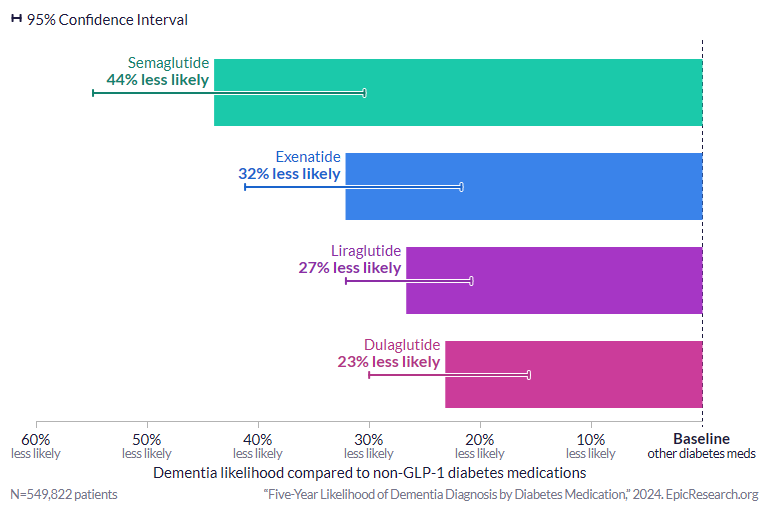
Patients with diabetes who are prescribed semaglutide, exenatide, liraglutide, or dulaglutide experience a 23–44% reduced likelihood of dementia compared to those prescribed other diabetes management medications.
 Expand
Children with a type 1 diabetic sibling have lower rates of overweight, obese, or severely obese BMIs compared to those without a sibling with diabetes, though this finding was not statistically significant.
 Expand
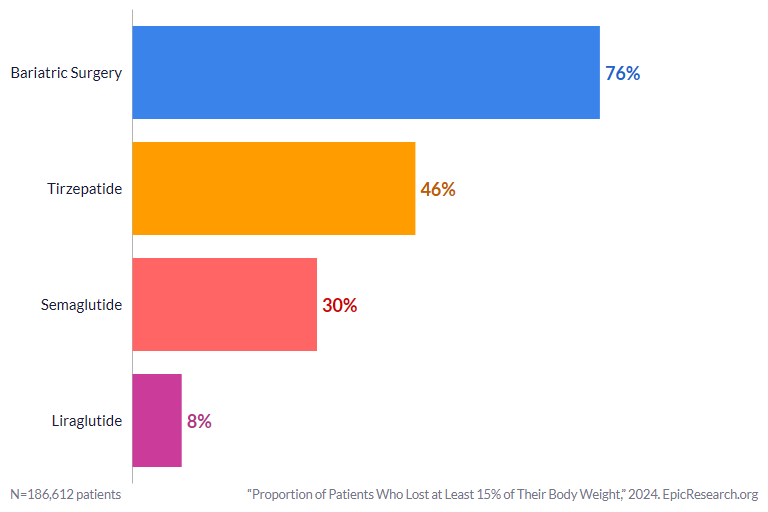
76% of patients who undergo bariatric surgery lose at least 15% of their starting weight within a year, compared to 46% of patients prescribed tirzepatide, 30% of patients prescribed semaglutide, and 8% of patients prescribed liraglutide.
 Expand
Patients with hypertension who are treated with loop and thiazide diuretics in addition to a calcium channel blocker are 16% more likely to be diagnosed with a bone density condition within three years compared to those treated with just a calcium channel blocker.
 Expand
Patients with hypothyroidism who lose more than five pounds after starting a GLP-1 medication experience on average a 0.36 mU/L to 0.55 mU/L reduction of their thyroid-stimulating hormone (TSH) levels.
 Expand
More than half of the children who tested positive for lead exposure at 24 months old were negative for lead exposure at 12 months old.
 Expand
Between 2017 and 2023, the rate of emergency department (ED) visits related to caffeine overdose or adverse effects more than doubled for children aged 11 to 14, increasing from 3.1 to 6.6 per 100,000 visits. For those aged 15 to 18, the rate rose from 7.4 to 13.6 per 100,000 visits.
 Expand
The rate of new asthma diagnoses decreased during 2020 and 2021, coinciding with the COVID-19 pandemic. In 2023, rates remained low for patients 12 years of age and older but returned to pre-pandemic levels for those under 12 years old.
 Expand
Patients prescribed semaglutide or liraglutide showed no significant change in their inflammatory marker levels compared to those not prescribed a GLP-1 medication.
 Expand
Pregnancy rates for women aged 18 to 50 who are prescribed GLP-1 medications are similar to those for women who are not prescribed GLP-1 medications.
 Expand
Among patients prescribed fluticasone propionate, the rate of asthma-related admissions, ICU stays, and ED visits was greater in the first and second quarters of 2024, after Flovent stopped being manufactured, than the average rates of the same quarters in 2022 and 2023.
 Expand
Firstborn children who have siblings are 48% more likely to have anxiety and 35% more likely to have depression compared to children who are born second or later.
 Expand
Self-pay emergency visits are on the rise in all age groups since the end of Medicaid continuous enrollment.
 Expand
5.2% of patients who have undergone CAR T-cell therapy develop secondary cancer within a year, including both metastatic cancers and second primary cancers, with small variations by medication.
 Expand
Patients with gallstones or gallbladder inflammation who have their gallbladder removed are nearly 20% less likely to be diagnosed with ulcerative colitis or Crohn’s disease than those who do not have their gallbladder removed.
 Expand
Despite recommendations not to test or treat strep in patients under age 3, 1-year-olds are tested 8.1% of the time and 2-year-olds are tested 13.7% of the time in encounters with respiratory-related symptoms.
